Who's Watching the Watchers? Why Workday Governance Decides Your Go-Live Outcome
When one vendor controls the plan, the resources, and the change narrative, governance becomes theatre. Here is what real client-side oversight looks like.
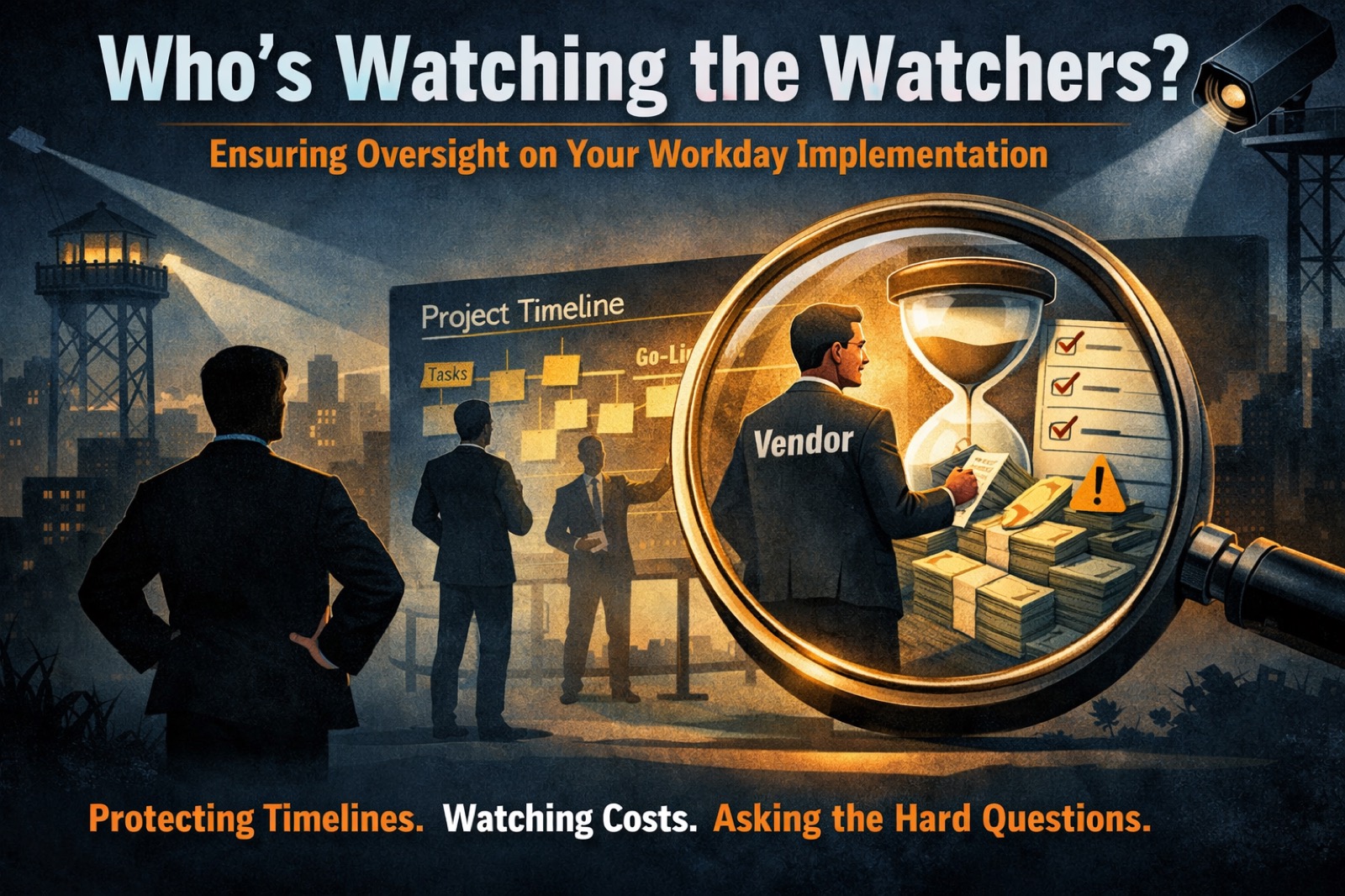
Every Workday programme starts with good intentions. Strong executive sponsorship. An experienced systems integrator. A signed statement of work that feels comprehensive. A timeline that looks achievable.
And yet the most painful failures rarely come from bad technology or resistant end users. They come from a simple question that no one asked early enough: who is actually protecting the client's interests once the project is underway?
Not who is running the plan. Not who is billing the hours. Not who is delivering the configuration. Who is watching the watchers?
Governance is risk management, not bureaucracy
Governance gets a bad reputation in programme delivery. It is often framed as overhead: something that slows teams down, adds meetings to already packed calendars, and creates reporting that no one reads.
That is a fundamental misunderstanding of what governance does on a Workday programme.
Governance is not about meetings. It is about control. It is not about reporting. It is about accountability. It is not about mistrust. It is about clarity.
Without strong governance, decisions drift. Scope erodes quietly, not through dramatic change events, but through small concessions made in design workshops that no one tracks cumulatively. A business process gets added here. An integration requirement gets expanded there. Each one feels reasonable in isolation. But six months later, the programme is three months behind and £400K over budget, and no one can point to the moment it went wrong, because there was not one moment. There were two hundred small ones.
Good governance creates friction early so you avoid failure later. It forces decisions to be documented, assumptions to be validated, and trade-offs to be made consciously rather than by default.
Your implementation partner is not your watchdog
This is the part that makes people uncomfortable, but it matters.
Your implementation partner is incentivised to deliver the work they are contracted to deliver, to the timeline they committed to. They are measured on utilisation, margin, and throughput, and they have new projects waiting to be staffed with those same consultants. That does not make them bad actors. It makes them a business.
But it does mean several things that rarely get acknowledged.
They will not slow things down to protect you if slowing down means their consultants sit idle for two weeks while your team catches up on decisions they have not made. They are not incentivised to challenge optimistic timelines you approved, because those timelines determine their revenue forecast. They are not incentivised to highlight downstream risk if raising it threatens delivery momentum, especially if the risk sits in a phase they will not be responsible for.
This pattern repeats. An SI programme manager raises a concern in an internal meeting. Their engagement partner overrules it because escalating the issue might threaten the client relationship or trigger a difficult conversation about additional budget. The concern gets documented in an internal risk log the client never sees. Three months later, it becomes a production defect.
When a single vendor controls the plan, the resources, the estimates, and the change narrative, governance becomes performative instead of protective. The steering committee receives green status reports. The executive sponsor feels confident. And beneath the surface, risks accumulate without scrutiny.
That is not oversight. That is theatre.
Client-side advocacy functions like insurance
Think about how you insure anything that matters.
You insure your house not because you expect it to burn down, but because you understand the cost if it does. You insure your car not because you plan to crash, but because risk exists regardless of how carefully you drive.
A client-side advocate on a Workday programme functions the same way. They are there to ask the questions others are not incentivised to ask. They are there to slow decisions that feel rushed: like approving a change order in 48 hours because the SI says it is "blocking delivery" when in reality it is blocking their preferred sequencing. They are there to challenge scope trades that look harmless today but create technical debt that explodes six months after go-live.
They are independent. They sit on the client side of the table. And most importantly, they answer to outcomes, not billable hours.
The difference is tangible. On one programme, the SI submitted a change order for £120K of additional integration work, justified by a "newly discovered technical dependency." A review of the original SOW and the design documents told a different story. The dependency was already documented in the SI's own architecture review from month two. The change order was the SI correcting their own underestimation and passing the cost to the client. Without someone on the client side who knew where to look and what to look for, that change order would have been approved in the next steering committee as a matter of course.
That single intervention paid for the entire engagement.
What happens when no one is watching closely
When governance is weak or symbolic, the same patterns repeat.
Timelines compress without revisiting assumptions. The programme falls behind in design because business decisions take longer than the SI estimated. Rather than extending the timeline and having an honest conversation with the sponsor, the SI compresses testing to protect the go-live date. The plan still shows the same end date, but the testing window that was originally eight weeks is now four. No one formally approved that trade-off because no one presented it as a trade-off. It just happened.
Design compromises get deferred as "phase two items" that never return. During design workshops, the SI recommends simplifying a complex business process to keep the programme on track. The business reluctantly agrees, on the understanding that the full requirement will be addressed in phase two. But phase two has not been funded, scoped, or committed to. It exists only as a verbal promise in a workshop. Twelve months later, the business is running a workaround they were told would be temporary, and there is no budget or appetite for a phase two that was never formally planned.
Change orders feel reactive instead of strategic. A change order lands for £80K of additional data migration work, justified by "unexpected complexity in the legacy system." But legacy data complexity is never unexpected. It is one of the most predictable risks in any Workday deployment. An experienced governance lead would have insisted on a data assessment in the first month and built contingency into the migration estimate. Instead, the client is paying for the SI's optimistic scoping.
Executives hear green while delivery teams feel red. This is the most dangerous pattern. The SI's status report shows the programme on track. The PM's weekly update is optimistic. But in the delivery trenches, the integration team knows they are behind. The testing team knows the scripts are not ready. The data migration team knows the data quality is worse than anyone has acknowledged. These signals exist. They are just not reaching the people who need to hear them because the reporting structure filters reality rather than transmitting it.
None of this happens all at once. It happens quietly. Incrementally. Reasonably.
Until cutover weekend. Until payroll parallel. Until first close.
That is when governance failures surface. And by then, the options are limited and expensive.
What strong governance actually looks like
Strong governance does not mean mistrusting your implementation partner. It means balancing the room.
It means someone who can say "that risk needs to be documented and owned, not just acknowledged," and has the authority to make sure it happens. Someone who can say "this dependency is not assigned to anyone, and if it slips, it takes the integration timeline with it." Someone who can say "we are trading long-term stability for short-term speed: is that a conscious decision the sponsor has approved, or is it happening by default?"
It also means someone who can translate between executives and delivery teams without filtering reality. The sponsor needs to know that testing is behind. Not wrapped in qualifiers and caveats, but stated plainly with options and recommendations. The delivery teams need to know that the sponsor's timeline expectation has not changed, and what that means for their workload and priorities.
That translation role is rarely fulfilled by the vendor. The SI's programme manager is structurally conflicted: they need to keep their own leadership happy while managing the client relationship. And it should not be left to a client PM who is already consumed by day-to-day task coordination and does not have the bandwidth or the seniority to force governance conversations at executive level.
It requires someone whose sole purpose is protecting the client's outcome. Someone with enough Workday delivery experience to recognise the patterns, enough authority to act on them, and enough independence to tell the truth when the truth is uncomfortable.
The cost of governance is predictable. The cost of not having it is not.
Strong governance feels like an investment. Weak governance feels cheaper, until it is not.
The costs of inadequate governance do not appear in the original business case, but they appear in real life. Rework that consumes months of effort. Extended dependency on the SI's application management services because the system was not implemented correctly the first time. Delayed value realisation because the go-live was pushed back, or worse, because the go-live happened on schedule but the system was not ready. Internal teams burned out by a programme that demanded more of them than anyone planned for. Executive confidence eroded to the point where the next transformation initiative faces institutional resistance before it even starts.
The most successful Workday programmes share one thing. Someone is explicitly accountable for protecting the client's outcome. Not delivering configuration. Not chasing tasks. Not billing hours. Protecting the programme.
How we deliver this at 360 HCM
This is the core of what COMPaaS was built for. Our programme oversight service provides fractional, senior governance leadership that sits entirely on the client side of the table. We establish the governance structure, lead steering committees, manage scope boundaries, challenge change orders with an insider's understanding of how they are constructed, and make sure what reaches the executive sponsor is reality, not a filtered version of it.
We do this because we have sat on the other side. We have been the SI engagement partners managing margin and utilisation. We have seen how governance gets diluted when the same organisation responsible for delivery is also responsible for oversight. There is a better model: one where the client has their own experienced voice in the room from day one.
Where to start
If you are planning a Workday programme and governance is not yet defined, or you are already in a programme and the patterns described above feel familiar, book a free Risk Review. We will discuss your programme's governance structure, current risks, and upcoming milestones.
If you'd prefer a structured self-check first, our free programme risk scorecard takes about five minutes and covers the governance gaps that most often surface in the final quarter before go-live.
No obligation. No sales pitch. Just an honest read on whether your governance setup will protect the outcome.